
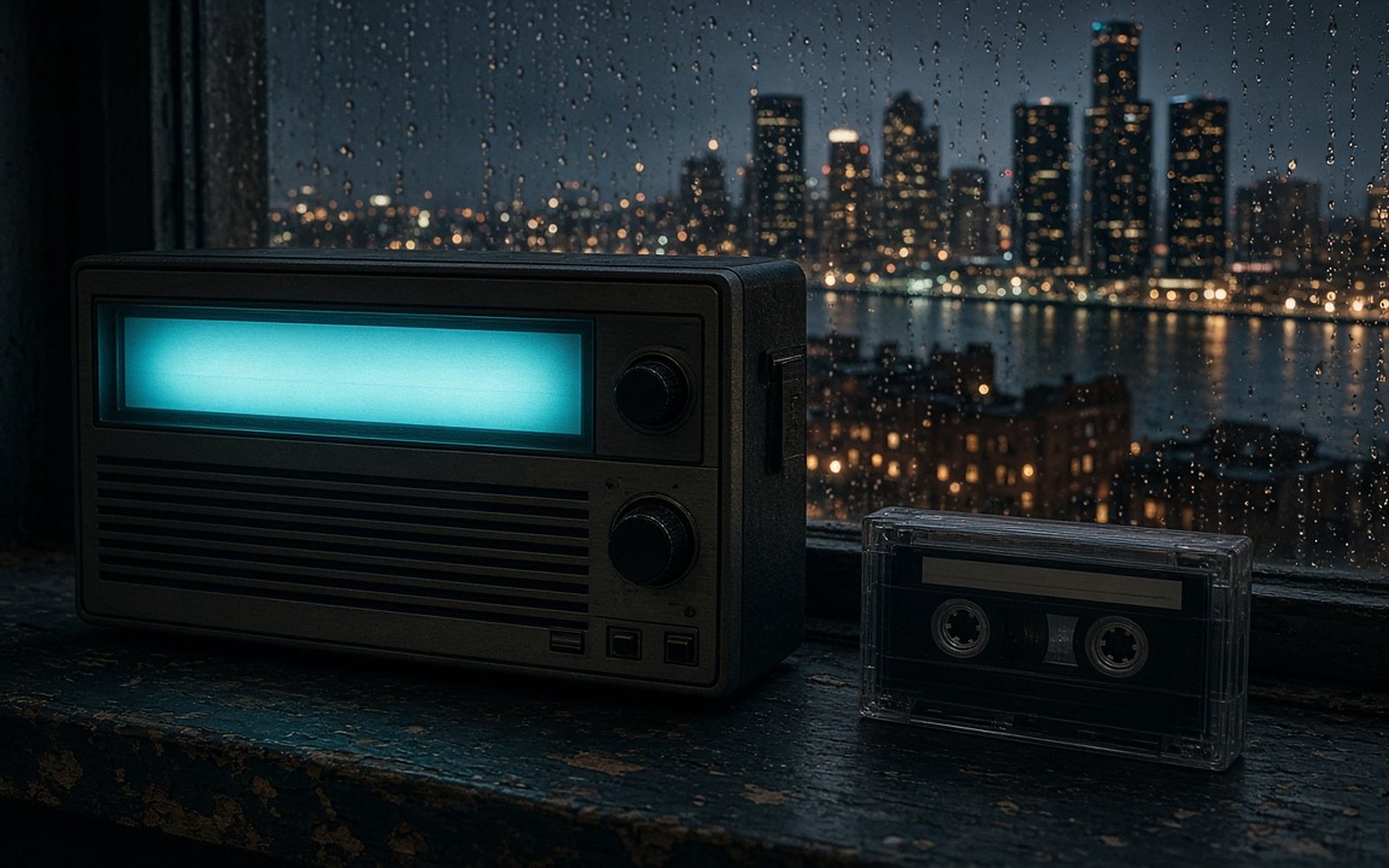
In an age of infinite playlists, why would anyone press play on a radio station? In most cities, it’s a fair question. In Detroit, the answer is written into the history of the music. Techno, the city’s great export, was shaped on the radio before it filled clubs around the world. That history is why 313 LIVE exists, and why internet radio still matters here.
Detroit’s music was raised on the radio
Ask Detroit’s techno pioneers about their influences and one name comes up again and again: the Electrifying Mojo. Charles Johnson’s programs began in the late 1970s in Ann Arbor and ran through the 1980s and 1990s in Detroit, most famously as The Midnight Funk Association. Mojo rarely showed his face and played whatever he believed in: Prince next to Kraftwerk, Parliament next to the B-52’s, funk next to European synth-pop.
For three teenagers from Belleville, Juan Atkins, Derrick May and Kevin Saunderson, those broadcasts were a classroom. Atkins has described listening religiously every night. Mojo didn’t just inspire the music; he played it. Local records like A Number of Names’ “Sharevari” and Cybotron’s “Alleys of Your Mind” got early airplay on his shows. Carl Craig has said that without Mojo, Detroit techno wouldn’t be the music we know.
A few years later came the Wizard. From 1986 to 1989, a young Jeff Mills mixed on WJLB, cutting techno, hip-hop and electro together at speeds that seemed impossible. Before he co-founded Underground Resistance and became one of the most influential DJs in the world, Mills was teaching a city’s radio audience what a mix could do. Read more in Jeff Mills: The Wizard’s Techno Still Dominates Peak Time.
That’s the Detroit lesson. Radio wasn’t background. It was where the city heard its own future first.
What playlists can’t do
Streaming services gave everyone access to almost every record ever made. That’s a gift. But access isn’t the same as discovery, and a playlist built from what you already like tends to keep you where you are. Radio, at its best, does a few things algorithms struggle with:
It makes choices for you
A station has a point of view. On 313 LIVE, that point of view is Detroit: the city’s techno, house and electro, and the music made around the world by people who learned from it. You hear records you’d never have searched for, placed next to records that explain them. That’s what Mojo did, and it’s what curation still means.
It’s shared
When you listen to a live stream, everyone tuned in hears the same record at the same moment: a listener on the East Side, someone on a night shift in Dearborn, a fan on the other side of the world. That simultaneity is radio’s oldest magic, and the internet has made it global without making it smaller. We wrote about that shift in From Warehouse to Web: How Detroit Radio Evolved.
It follows the clock
A good station sounds different at 8 a.m. than at 2 a.m., because people’s lives do. 313 LIVE is programmed in four dayparts, from the warm deep house of Morning Rise to the long arcs of Late Night Deep. The daypart guide explains each one.
It teaches
Radio used to leave you guessing what that track was. Internet radio doesn’t have to. Every record on 313 LIVE appears on the recently played page, searchable back up to seven days, with a link to find it on Bandcamp. The stream becomes a syllabus: labels, artists and eras, one track at a time. Our starter dig guide shows how to use it.
It talks back
Listeners can shape what plays. On 313 LIVE, the requests page lets you search the station library and queue a track during Studio 13 hours, the station’s programmed rotation. It’s a small thing, but it turns a broadcast into a conversation. See Requesting Tracks the Right Way.
Why it matters in Detroit specifically
Detroit’s electronic music has always traveled. The 1988 UK compilation Techno! The New Dance Sound of Detroit gave the music its name abroad, and for decades the city’s artists often found bigger audiences in Europe than at home. Since 2000, when the Detroit Electronic Music Festival first filled Hart Plaza, the event now known as Movement has brought the world back to the city on Memorial Day weekend. The rest of the year, the music needs places to live at home, too.
A Detroit internet station is one of those places. It keeps the city’s own sound in its own hands: programmed from here, built around the city’s history, and open to anyone with a connection. It gives local and foundational names steady airplay. It gives listeners elsewhere a direct line into the source instead of a secondhand version. And it gives the next generation what Mojo gave the last one: a reason to stay up late and listen.
Radio that doesn’t cost you anything
313 LIVE is free to listen to, with no paywall and no account. You can hear it in a browser, install it as an app on your phone, or open the station’s playlist in VLC, Apple Music or any radio app. Here’s how to listen anywhere.
Free doesn’t mean costless. Streaming, servers and upkeep are paid for every month by listeners and local sponsors. If the station is part of your day, the support page lists ways to help, from sharing the stream to sponsoring it. Read Support the Culture for the bigger picture.
Keep the signal on
In Detroit, the future has always come through the airwaves first. The technology has changed from FM towers to streams and phones, but the job is the same: play what matters, play it with intent, and let the city hear itself.
New here? Start with the complete guide to 313 LIVE, then press play on the live player.
FAQ
Who was the Electrifying Mojo?
Charles Johnson, a Detroit radio DJ whose shows, starting in the late 1970s, mixed funk, Prince, Kraftwerk and new electronic music. He influenced the Belleville Three and played early Detroit techno records on air.
Was Jeff Mills a radio DJ?
Yes. As “The Wizard,” Jeff Mills mixed on Detroit’s WJLB from 1986 to 1989, known for his speed and his blend of techno, hip-hop and electro.
Is there a Detroit techno radio station online?
Yes. 313 LIVE streams Detroit techno, house and electro 24/7 at 313live.org, free and with no sign-up.

Comments
No comments yet.
Leave a comment