
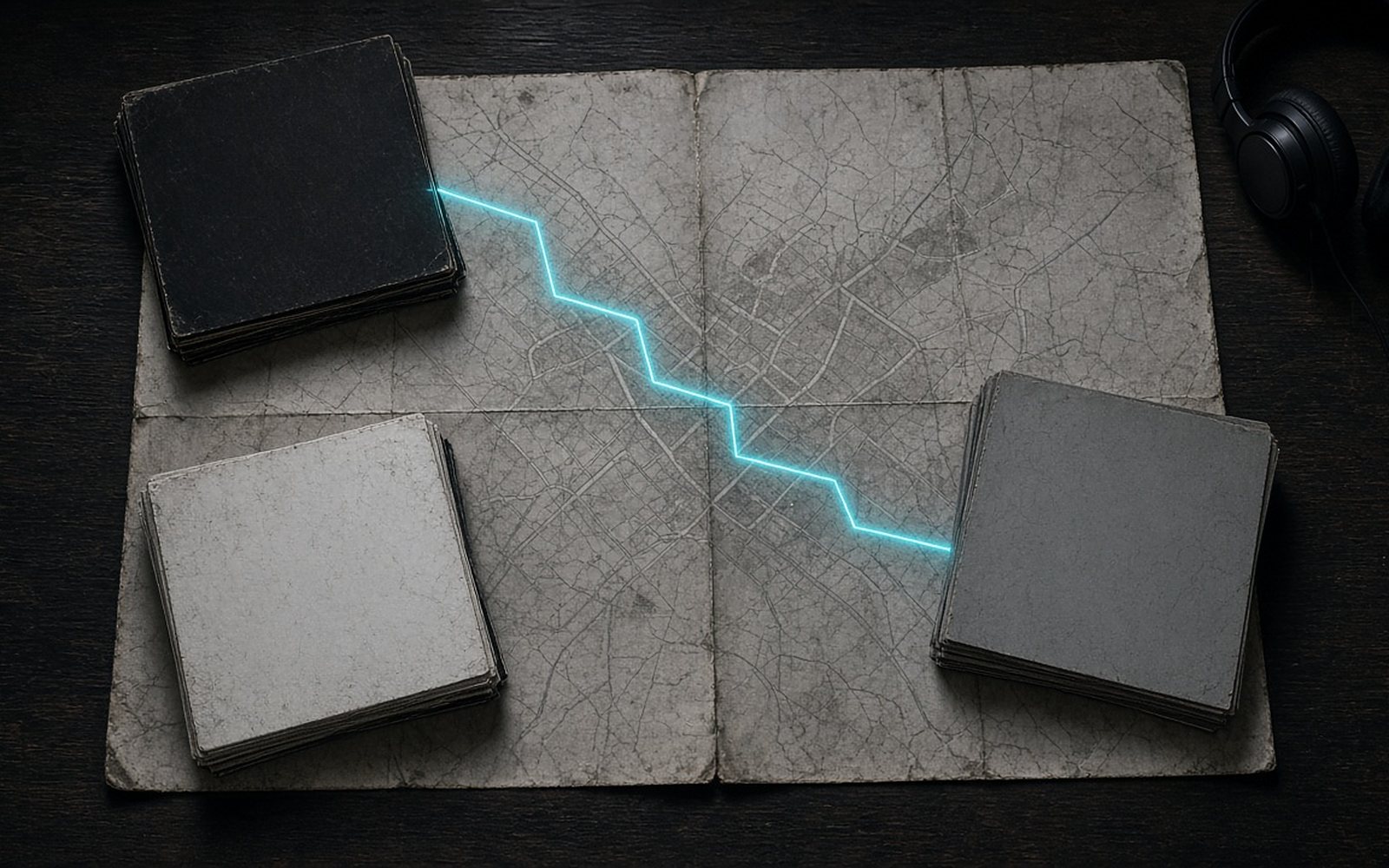
Detroit gave the world three electronic sounds that are related but different: techno, house and electro. Newcomers often hear them as one thing. Longtime heads argue about where one ends and the next begins. This map is for the listener in between, someone who has heard enough on 313 LIVE to know they like it and wants to understand what they’re hearing.
It isn’t another list of essential artists. We already have a Detroit techno starter dig with ten touchstones. This is a map of the territory: what each sound feels like, where they meet, and which route to take depending on what you already love.
One city, one toolkit
All three sounds share the same roots: Black Detroit’s love of funk and soul, a fascination with European synth-pop, especially Kraftwerk, and cheap drum machines and synthesizers that made it possible to build music at home. Much of it came through the radio, where the Electrifying Mojo played Kraftwerk next to Parliament and Prince for a generation of future producers.
From that shared toolkit, three dialects grew. The quickest way to tell them apart is to listen to the drums.
The three territories
Electro: the broken beat
Listen for: drums that don’t march in a straight line. Electro uses syncopated, broken drum-machine patterns, closer to funk and early hip-hop than to the steady four-on-the-floor kick. Add robotic vocals, sci-fi themes and deep bass.
Where it came from: in Detroit, Cybotron, the duo of Juan Atkins and Richard “3070” Davis, made the blueprint with “Alleys of Your Mind” (1981) and “Clear” (1983). In the 1990s, Drexciya built an entire underwater mythology around the sound, and AUX 88 led a street-level revival.
Go deeper: Electro in the 313: From Cybotron to Modern Machines.
Techno: the machine pulse
Listen for: a steady kick drum on every beat, synthesizer patterns that loop and evolve, and a feeling that is at once mechanical and emotional. Detroit techno often carries strings, pads or melodies that feel strangely tender for music made by machines.
Where it came from: the Belleville Three, Juan Atkins, Derrick May and Kevin Saunderson, through Atkins’s Model 500 project, May’s “Strings of Life” (1987) and Saunderson’s work. The name arrived with the 1988 UK compilation Techno! The New Dance Sound of Detroit. A second wave, led by Underground Resistance, founded in 1989, made it harder, more political and more independent.
Go deeper: The Belleville Three, Underground Resistance and Labels That Built the Detroit Myth.
House: the human swing
Listen for: the same four-on-the-floor kick as techno, but warmer and looser: swung hi-hats, soul and disco samples, vocals, chords that feel like a church or a basement party. If techno faces the future, house feels at home in the room.
Where it came from: house was born in Chicago, and Detroit built its own deep tradition alongside it, with DJs like Ken Collier at the center of the city’s club culture. Moodymann and Theo Parrish are the names most listeners meet first: raw, sample-rich, patient music that sounds like nowhere else.
Go deeper: Moodymann: Raw Detroit House and Theo Parrish: Sound Signature.
Where the territories meet
The borders are where Detroit gets most interesting. Four crossings to know:
- Techno and house: Kevin Saunderson. Inner City’s “Big Fun” and “Good Life” (both 1988) are house-shaped songs made by a techno founder, and they took Detroit to the pop charts. See Kevin Saunderson: From Inner City to Global House Floors.
- Techno and electro: Juan Atkins. The same artist who made electro’s Detroit blueprint with Cybotron went on to shape techno as Model 500. See Juan Atkins: The Originator.
- Techno and everything: Carl Craig. His Planet E label moves between techno, jazz, house and the abstract, and he helped launch the Detroit Electronic Music Festival at Hart Plaza in 2000, the event now called Movement. See Carl Craig: Planet E and the Expansive Detroit Sound.
- Across the river: Detroit and Windsor. Richie Hawtin’s Plus 8 and Minus work shows the region as one creative zone. See Richie Hawtin: Minus Aesthetics and Cross-Border Techno.
And then there’s ghettotech, the fast, raw, party-first Detroit style that emerged in the mid-1990s from DJs blending techno, electro, Miami bass and Chicago ghetto house. DJ Assault and DJ Godfather are among its pioneers. It’s the reminder that Detroit electronic music was always for dancing, not just for listening.
Pick your route
The fastest way into the map is through music you already love.
If you love hip-hop, funk or breakbeats
Start with electro. The broken beats will feel familiar. Then follow the line into techno through Juan Atkins. On 313 LIVE, electro surfaces through the core rotation and is part of the mix in Evening Build and Late Night Deep.
If you love soul, disco or R&B
Start with Detroit house: the samples and the swing will pull you in. Then cross into techno through Kevin Saunderson and Inner City. On 313 LIVE, the Morning Rise and Daytime Groove dayparts lean this way.
If you love synth-pop, ambient or film scores
Start with the melodic side of techno: Derrick May’s strings, Carl Craig’s range. Then go deep and minimal with Robert Hood. Read Derrick May and the Emotional Core of Detroit Techno.
If you love hard, fast music
Start with second-wave techno: Underground Resistance and Jeff Mills. Then see where the speed went with ghettotech. Read Jeff Mills: The Wizard and Peak-Time Techno. On the station, Evening Build is your daypart.
How to use the map on 313 LIVE
A map is only useful if you take it outside. Three ways to put this one to work:
- Listen by the hour. Each daypart leans toward a different part of the territory. The daypart guide shows which.
- Read the tracklist. When something hits, open recently played. Which territory was it in? Which label? Follow the Find link to Bandcamp and keep digging.
- Request across a border. Search the request library for an artist from a neighboring territory and hear how it sits in the flow. Our request etiquette guide explains how to do that well.
Two more stops before you go. The history isn’t complete without the women who built it, so read Women Who Built Detroit Electronic Music. And for everything about the station itself, from the stream to Studio 13, see the complete 313 LIVE guide.
Starter map FAQ
What is the difference between Detroit techno and house?
Both use a steady four-on-the-floor kick. Detroit techno leans on synthesizer patterns and a futurist, machine feel. House is warmer and looser, built on swing, soul and disco samples and vocals.
What is the difference between techno and electro?
The drums. Techno runs on a steady kick on every beat. Electro uses broken, syncopated drum-machine patterns closer to funk and early hip-hop, often with robotic vocals.
Is house music from Detroit or Chicago?
House was born in Chicago. Detroit developed its own influential house tradition alongside it, known for raw, soulful, sample-rich records from artists like Moodymann and Theo Parrish.
What is ghettotech?
A fast, raw Detroit dance style from the mid-1990s that blends techno, electro, Miami bass and Chicago ghetto house. DJ Assault and DJ Godfather are among its pioneers.
Comments
No comments yet.
Leave a comment